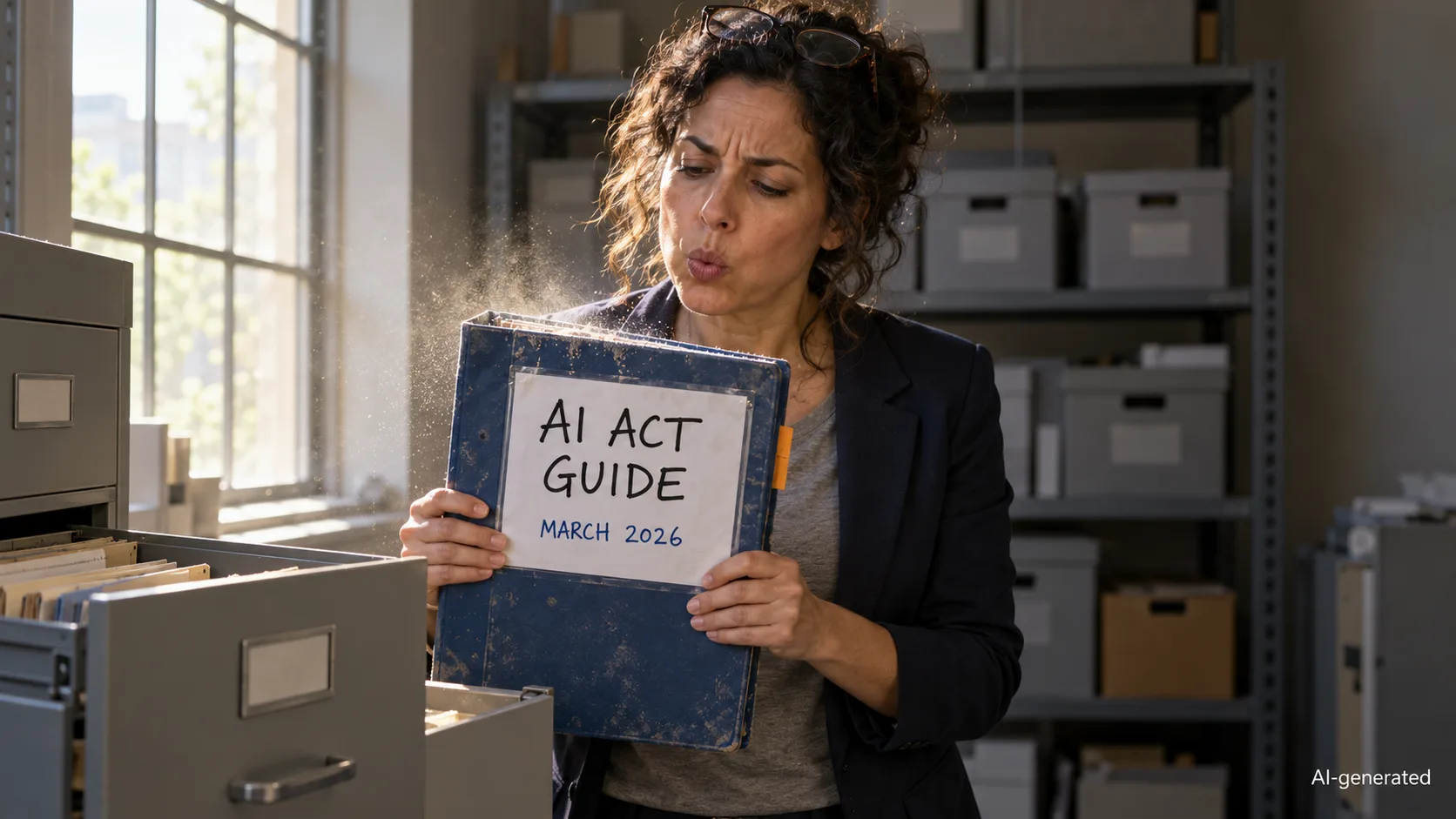
If you were given EU AI Act advice for your small business before August 2026, check it again.
In July the EU changed the AI Act with a second law, the Digital Omnibus, in force since 27 July 2026. Some articles were rewritten and some were added. Guides written before then may quote wording that has since changed.
You don't need a lawyer to spot that. You need the date on the advice and five minutes with the official text.
Why does good AI Act advice go out of date?
Because the law changed after it was written. The AI Act was first published in 2024, and any guidance from before July was written against that version. It wasn't wrong at the time. The law moved under it.
I check the AI Act every week, and in September even the European Commission's own AI Act website was behind. My notes listed a 2 December 2026 deadline for some AI companies to mark what their tools make as AI-generated. The official page for that article showed only three paragraphs.
The deadline sat in a fourth paragraph, added by the new law, and the page hadn't caught up. It has now, marked NEW.
Three checks for any piece of AI Act advice
1. When was it written?
Look for a date on the guide, the email or the slides. Anything from before 27 July 2026 was written against the old text. That doesn't make it wrong. It means you check it before you rely on it.
No date at all? Treat it as old.
2. Does the article it quotes still say that?
Open the European Commission's free AI Act Service Desk at ai-act-service-desk.ec.europa.eu and look up the article number the advice quotes. The page tells you which version you're reading, and anything the new law changed is labelled NEW or AMENDED.
If it's marked AMENDED, read the current wording. You don't need to follow every line of it. You're only checking whether it still says what your advice says it does.
3. Can they show you the sentence?
If you can't find what the advice quotes, ask whoever wrote it to show you the exact sentence and where it comes from. Someone who knows the law can do that in a minute. If they can't, you've got an opinion, not a rule.
What to do with what you find
The checks leave you with one of four answers. Here's what to do with each.
| What you find | What it means | What to do |
|---|---|---|
| Written after 27 July 2026 | It was written against the current text | Use it |
| Older, but the article isn't marked NEW or AMENDED | That wording still stands | Use it, and check any dates it gives |
| The article is marked NEW or AMENDED | The advice may quote the old wording | Read the current wording and go with that |
| You can't find it, and nobody can show you | There's no way to check it | Don't act on it yet |
What you end up with
Two piles: advice you can rely on, and advice to check again. Some of what you were told will still stand. The point is knowing which bits.
The traps that catch people
"The AI Act was delayed"
Half true. The high-risk rules moved. The rules on being open with people when AI is involved didn't. Those have applied since 2 August 2026.
The one extra bit of time is narrow. Companies whose AI tools create images, audio, video or text, and were on the market before 2 August 2026, have until 2 December 2026 to mark that content as AI-generated. That's for the companies making those tools, not the businesses using them. Who Has to Label AI-Generated Content Under the EU AI Act? goes through who has to do what.
Old wording on AI literacy
The 2024 text asked businesses to ensure a "sufficient level" of AI literacy among their staff. Article 4 was rewritten in July. Now providers and deployers must take measures to support AI literacy, and the article says it "does not require providers or deployers to guarantee any specific level of AI literacy of any individual".
Advice that talks about reaching a sufficient level is quoting the old wording.
Old high-risk dates
The rules for high-risk AI systems now start on 2 December 2027, or on 2 August 2028 for AI built into products already covered by EU safety rules, such as machinery or medical devices. Advice that gives an earlier start date for those rules is working from the old text.
For the full list of what changed for a small business, see Does the EU AI Act Apply to My Small Business?
"I couldn't find it, so it's wrong"
Not always. In September the official page itself was behind. A missing paragraph can mean an old copy, not a made-up rule. Ask for the sentence before you decide either way.
Common questions
Do I need a lawyer to check my AI Act advice?
Not to spot that it's out of date. The three checks above take about five minutes. Working out what the law means for your particular business is a separate job.
Where can I read the current AI Act?
The European Commission's AI Act Service Desk shows the Act with the July changes built in and labels each changed part NEW or AMENDED. It's free and you don't need an account.
Was the whole AI Act delayed?
No. The high-risk rules moved to 2027 and 2028. The rules on being open about AI have applied since 2 August 2026.
Where this leaves you
Dig out the AI Act advice you've been given and give it five minutes. If you act on an old version, you're the one who answers for it, not whoever wrote the guide.