

Featured image for The Founder Bottleneck: What's Stealing Your Time and How to Get It Back on SolvStream blog
Back to Blog
OperationsSolo ConsultingWorkflows

The Founder Bottleneck: What's Stealing Your Time and How to Get It Back

Shaun Richardson4 March 2026

You finish a client call, open a blank document, and start your proposal from scratch. Two hours later you've written something serviceable. You tell yourself it's bespoke work, that each client deserves fresh thinking. But what you're actually doing is burning hours on repetition instead of building. This is where SolvStream's approach makes a difference.

This is the founder bottleneck for solo consultants. It's not about approving expenses or Slack interruptions. It's far more structural than that.

The short version

Every client interaction, proposal and decision flows through your brain because nothing is systematised. You're not a bottleneck because you're controlling work. You're a bottleneck because you're doing all the work. The Fragmentation Tax you're paying is the time lost switching between identical tasks over and over. Fix this, and you unlock what your business could actually be. This applies whether you're a solo consultant, a service business owner, or running a small agency.

When everything starts from scratch

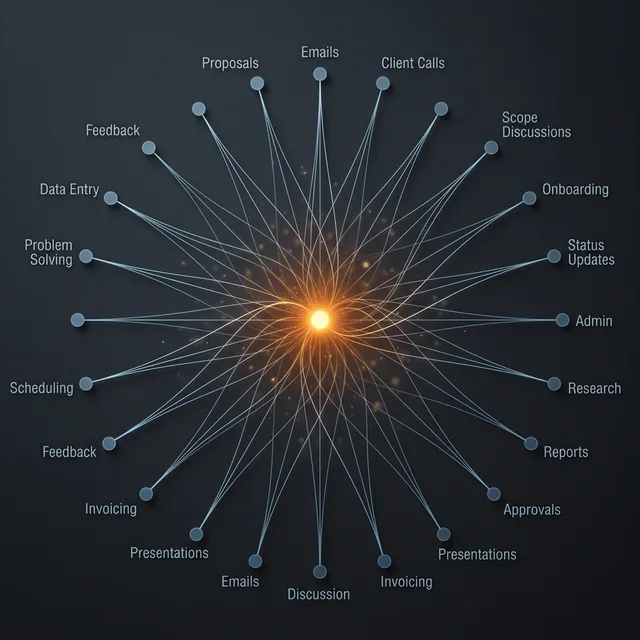
Most solo consultants describe their workday like this: proposal, email, client update, internal admin, proposal again. Each task is unique on the surface. Each one requires your attention fully.

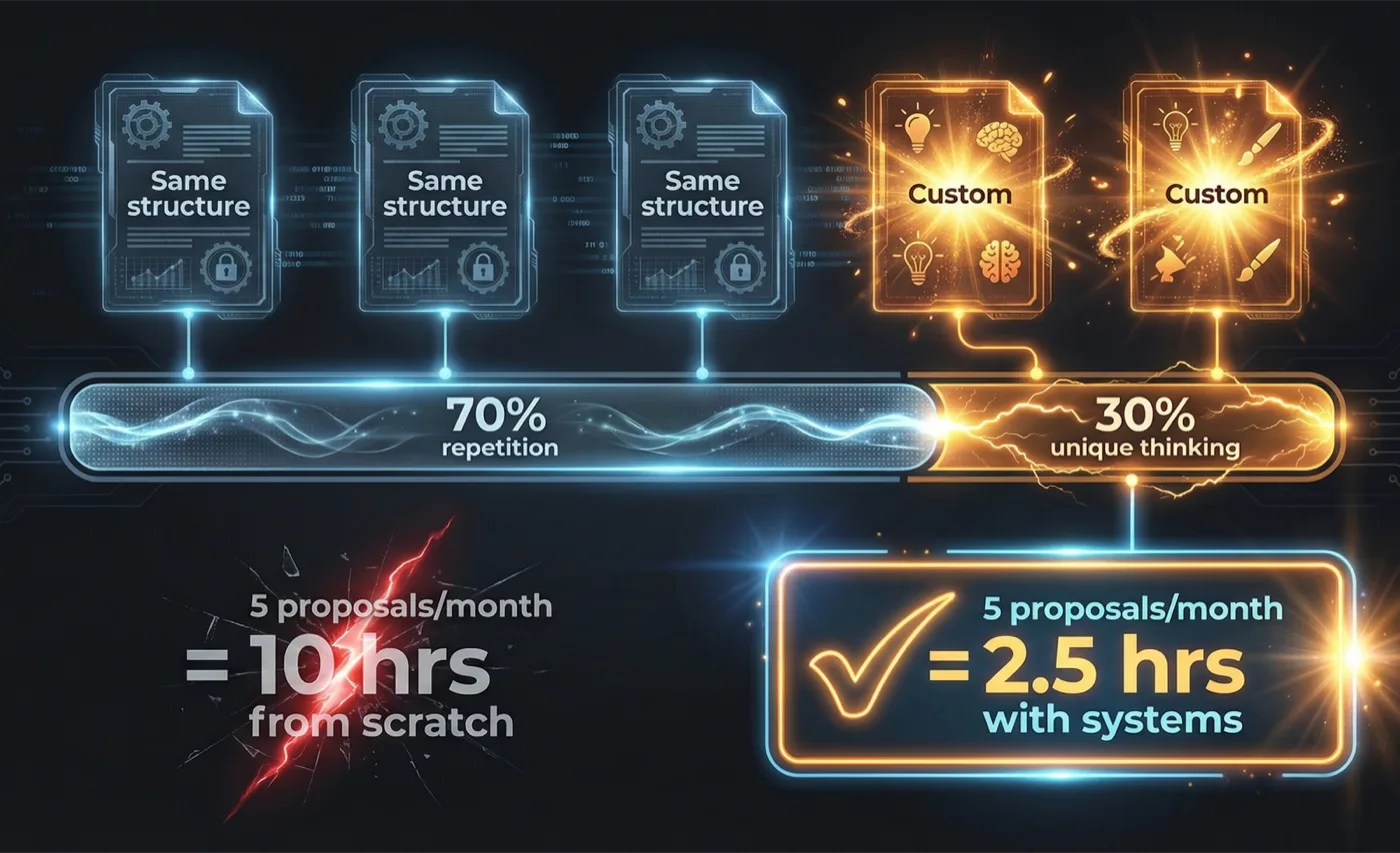
The real pattern isn't uniqueness. It's repetition disguised as custom work. You write five proposals a month and they're all 70% the same structure with 30% customised content. You answer the same seven questions across different client emails. You redo your monthly reporting using the same framework but different data.

This is the Fragmentation Tax at work.

Every time you start from scratch instead of from a system, you're burning cognitive energy on decisions that shouldn't need deciding. What font? What sections? How do I structure this? Who needs to know this happened? Each tiny decision multiplies across a month of work and disappears into hours you can't recover.

The solo consultant who writes five custom proposals from scratch burns roughly 10 hours. The one with a proposal framework, template questions and a repeatable process burns roughly 2.5 hours for the same result. That's not efficiency. That's seven hours a month you could spend on actual strategy... or just not working.

Why being the expert becomes the trap

You built your consultancy on deep expertise. You're the person clients hire because of what you know. This is real. And it creates a dangerous assumption: if something requires expertise, only you can do it.

This kills systematisation faster than anything else.

You write all your own proposals because clients need your thinking. You handle every scope discussion because you know what's realistic. You manage all client communications because you need to control the relationship. None of this is wrong reasoning until you realise you're spending 60% of your week on these things and wondering why you're not taking new clients.

The bottleneck isn't expertise. It's the belief that expertise must be personally involved in every output.

A proposal doesn't need your thinking on the title and structure. A scope discussion doesn't need you explaining what you do for the fifteenth time this month. A status email doesn't need your exact prose every time it goes out. These tasks contain pockets of true expertise, but they're embedded in a lot of repetition.

Separate the expertise from the execution, and something extraordinary happens. You can template the execution. You can document the thinking. You can give other people (or future-you) the pattern so the only variable is the 30% that actually matters.

The systems that change everything

One Week Ops Reset (SolvStream's signature framework) always starts the same way. A solo consultant walks through a typical week. By Tuesday afternoon, the work looks like this: proposal writing, email catch-up, a discovery call, internal admin, three Slack pings from past clients, another proposal, and the client update that somehow takes two hours because there's no standard format.

Nothing is systemised. Everything requires the person.

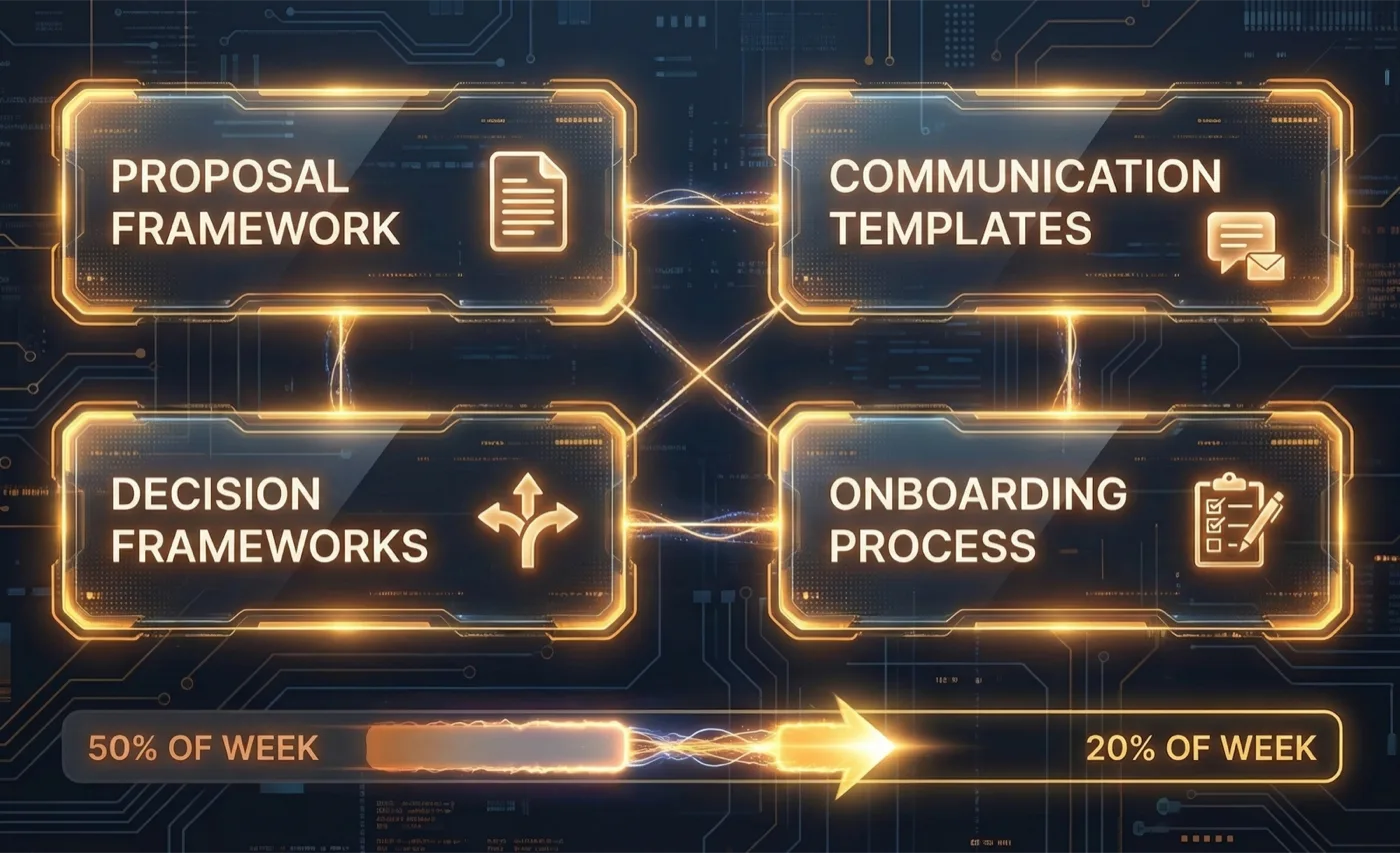
The shift happens when you build four core systems:

Proposal and delivery framework. Document your approach: how you diagnose work, what phases you use, what outcomes matter. This becomes your proposal skeleton. A new client proposal isn't a blank page anymore. It's: copy the framework, fill in specific details, done. You move from two hours to thirty minutes, and nothing important changed except the friction.

Communication templates. Client emails, status reports, discovery questions, scope confirmations. These sound boring until you realise you're answering the same questions weekly. Document the good ones. Build a library. When a client asks about timelines, you're not composing a new answer. You're choosing a template, personalising it, sending it. Same quality, ninety seconds instead of ten minutes.

Decision frameworks for common scenarios. A prospect asks if their project is in scope. A client wants to change deliverables mid-project. A past client contacts you for something small. Instead of thinking through each one fresh, you have a decision tree. This prevents context switching that drains your mental energy without adding any value.

Client onboarding process. When you win work, what happens? There's no system, so you wing it each time. Onboarding becomes: initial meeting, vague handoff, client confusion, follow-up emails. Build a process instead. Initial call covers X, your team sends checklist Y, week one includes Z. Clients know what to expect. You're not improvising.

These four systems do something remarkable. They take the work that was consuming 50% of your week and compress it to 20%. The quality doesn't drop because you're not systemising the expertise. You're systemising the repetitive parts so the expertise can actually breathe.

What changes when systems exist

Let's say you systematise for one month. Your proposal time drops from ten hours to three. Your email response time drops from two hours scattered across the day to thirty focused minutes. Your onboarding goes from chaotic to documented.

That's fourteen extra hours that month.

Most solo consultants don't immediately take on more clients with that time. They do something smarter: they think. They work on how they market the business. They design the service to be different, better, more defensible. They take a breath instead of drowning in execution.

The money might grow in three months. The sustainability grows immediately. You're no longer trapped in the daily routine of execution. You're building something that could actually scale, because it doesn't live inside your head anymore.

Over six months, the compound effect is not just that you have time back. It's that everything is teachable now. If you ever want to bring in a contractor or partner, or even just take actual vacation without responding to emails, the systems exist to make that possible. This is Operational Equity: each fixed workflow becomes infrastructure for the next, allowing you to compound your improvements and eventually scale beyond just yourself.

Most solo consultants never get here. They stay in the bottleneck for the entire life of the business because they never separate what needs their expertise from what just needs execution.

It's not about being lazy

The resistance most solo consultants feel is real. Systemising feels like admitting the work isn't special. It feels like you're reducing yourself to process, losing your edge.

This is exactly backwards.

The solo consultant who documents their approach, builds repeatable processes, and removes friction from execution isn't losing anything. They're amplifying their expertise by freeing themselves from the weight of repetition. They're saying: "The thinking I do is valuable enough to bottle. The execution is important but doesn't need my personal attention every single time."

This is actually what world-class work looks like. Every proposal isn't identical, but they're built from the same strong foundation. Every client communication carries your voice but doesn't require you to invent how to explain things for the first time, again.

The solo consultant who stays bottlenecked, who insists every proposal must be custom from scratch, who handles every email personally because it's important: they're not being professional. They're being inefficient. And inefficiency always sounds like virtue when you're exhausted.

Start here

Most solo consultants don't need more clients. They need fewer hours spent on execution. That means one thing: pick the one task that consumes the most time and causes the most friction in your week, and systematise it completely.

For many, that's proposals. For others, it's onboarding or status reporting. It doesn't matter which one. It matters that you break the pattern of starting from scratch.

Document what you do. Build a template. Test it on the next three instances. Time it. Improve it. That's the first crack in the bottleneck.

One systematised process won't transform everything. But it proves something: the expertise was never about the whole task. It was about the thinking. Everything else was just friction you'd gotten used to.

Once you see that, the rest falls into place.

Your time is coming back. It just needs systems to do the work your brain's been doing.

Shaun Richardson, founder of SolvStream

Shaun Richardson

Founder at SolvStream

Shaun helps business owners fix the operational bottlenecks that cost them time and momentum. His work blends practical operational thinking with focused AI integration, helping businesses build tools they'll actually use and processes that hold up under pressure.

Shaun writes about operational clarity, intelligent technology, and the quiet power of getting out of your own way.

Last updated: 4 March 2026

We use optional analytics cookies to understand how visitors use this site. No personal data is collected. Privacy Policy